
Demystifying Quantum Computing: The Future of Technology
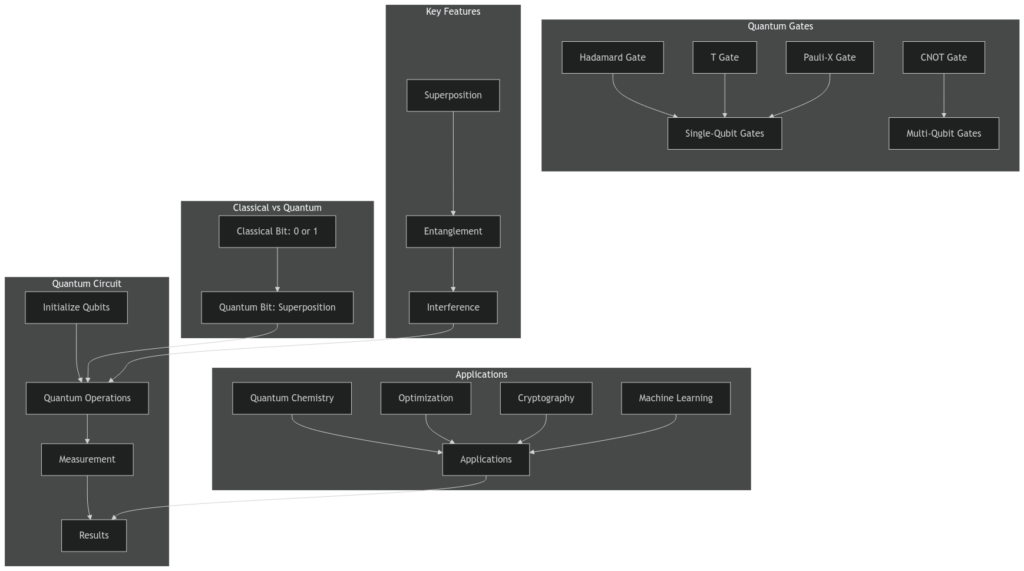
In the rapidly evolving landscape of technology, one term that frequently captures the imagination is “quantum computing.” Unlike classical computers, which process bits as 0s or 1s, quantum computers leverage the principles of quantum mechanics to operate on qubits. These qubits can exist in multiple states simultaneously, thanks to phenomena like superposition and entanglement, enabling quantum computers to solve complex problems at unprecedented speeds. In this blog entry, we’ll explore what quantum computing is, its potential applications, current challenges, and why it’s poised to revolutionize various industries. From below diagrams, we can see how quantum computing architecture was built and the concept make it possible.
Understanding Quantum Computing
The Basics: Bits vs. Qubits
Classical computers use bits as the smallest unit of data, which can be either 0 or 1. In contrast, qubits are the fundamental units of quantum information in quantum computing. Due to superposition, a qubit can represent both 0 and 1 at the same time, allowing quantum computers to process massive amounts of data simultaneously.
Key Principles: Superposition and Entanglement
- Superposition allows qubits to exist in multiple states until measured, providing the ability to handle complex calculations more efficiently.
- Entanglement is a phenomenon where qubits become interconnected such that the state of one qubit can depend on the state of another, no matter how far apart they are. This property enables quantum computers to perform tasks with remarkable coordination and speed.
Quantum Gates and Circuits
Quantum gates manipulate qubits through various operations, similar to classical logic gates but with more complexity due to their probabilistic nature. These gates form quantum circuits that can execute algorithms like Shor’s or Grover’s, which have the potential to solve problems considered intractable for classical computers.
Potential Applications
Cryptography and Security
Quantum computing poses both a threat and an opportunity in cryptography. Algorithms such as RSA rely on the difficulty of factoring large numbers—a task that quantum computers could perform efficiently using Shor’s algorithm, potentially breaking current encryption methods. However, this also paves the way for quantum key distribution (QKD), which promises theoretically unbreakable security through quantum mechanics.
Drug Discovery and Materials Science
The ability to simulate molecular interactions at a quantum level could revolutionize drug discovery by identifying potential compounds more quickly and accurately. Quantum computing can model complex molecules that are beyond the reach of classical simulations, potentially speeding up the development of new medications and materials with desirable properties.
Optimization Problems
Industries like logistics, finance, and energy management face optimization problems that require evaluating numerous variables simultaneously. Quantum algorithms could provide solutions far more efficiently than classical methods, optimizing supply chains, financial portfolios, or grid operations.
Current Challenges
Scalability and Error Rates
Building a scalable quantum computer remains a significant hurdle. Qubits are highly sensitive to their environment, leading to errors due to decoherence and noise. Researchers are working on error correction techniques and more stable qubit technologies to overcome these challenges.
Quantum Software Development
Developing software for quantum computers requires new programming paradigms and languages, such as Qiskit, Cirq, or Quipper. As the field is still in its infancy, there’s a steep learning curve for developers transitioning from classical to quantum computing.
Infrastructure and Investment
The infrastructure needed to support large-scale quantum computing operations is still under development. Significant investment from both public and private sectors is required to build the necessary facilities and research institutions that can advance this technology.
The Road Ahead
Quantum computing holds immense promise, but it’s essential to recognize that we’re in the early stages of its development. Collaboration between scientists, engineers, policymakers, and industry leaders will be crucial in overcoming current challenges and unlocking quantum computing’s full potential.
As we look to the future, embracing this groundbreaking technology could lead to innovations that reshape industries, enhance scientific understanding, and solve some of humanity’s most pressing problems. While classical computers continue to serve us well, the dawn of the quantum era heralds a new chapter in computational power—one that is as exciting as it is transformative.
In conclusion, quantum computing represents not just an evolution but a revolution in how we process information. By understanding its principles, potential applications, and challenges, we can better prepare for the profound changes it promises to bring. Stay tuned to this space as we continue exploring the fascinating journey of quantum computing!


Post Comment